
Q-Day is Coming: Why the "Quantum Apocalypse" Matters Now
The Clock is Ticking on Q-Day: Are You Ready? Quantum computers are coming to break the internet's encryption, and the "Harvest Now, Decrypt Later" threat means your data is already at risk. This guide breaks down exactly what Q-Day is, why you can't wait until 2030 to act, and the strategic roadmap organizations and individuals need to survive the "quantum apocalypse.
CLOUD TECHNOLOGIES
Abhishek Gupta
12/13/20255 min read
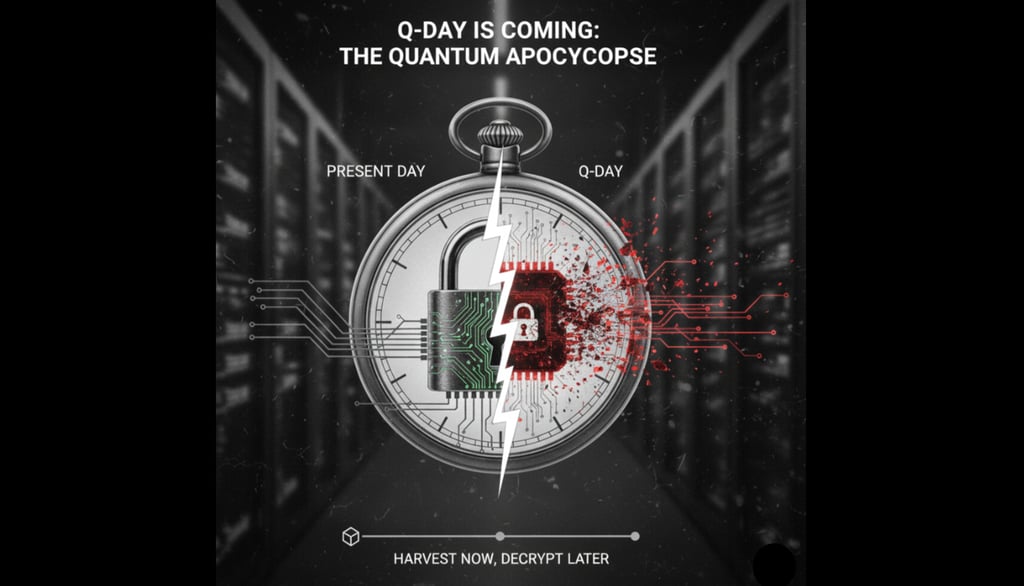

In the world of cybersecurity, there is a clock ticking down to a date that doesn't officially exist yet. Experts call it Q-Day.
It sounds like science fiction, but the threat is very real. Q-Day refers to the hypothetical future date when quantum computers become powerful enough to break the encryption standards that currently protect virtually all our digital secrets—from your banking passwords to national security secrets.
If you’ve heard the term and felt a wave of confusion or anxiety, you aren't alone. Here is everything you need to know about.
Q-Day, why you should care about it today, and how we can prepare for a post-quantum world.
When is Q-Day?
The short answer: We don't know exactly, but it’s getting closer.
Most experts estimate Q-Day will arrive sometime in the early to mid-2030s.
Optimistic estimates: Some aggressive predictions suggest a breakthrough could happen as early as 2028-2030.
Conservative estimates: Others believe we are safe until 2035 or later.
Regardless of the exact year, the consensus is that it is a "when," not an "if." The arrival of a Cryptographically Relevant Quantum Computer (CRQC) will render our current public-key encryption (like RSA and ECC) obsolete instantly.
Why Panic Now? The "Harvest Now, Decrypt Later" Threat
You might be thinking, "If this is 10 years away, why worry about it now?"
The reason is a strategic attack known as Harvest Now, Decrypt Later (HNDL).
Bad actors—including nation-states and criminal organizations—are already intercepting and storing vast amounts of encrypted data. They can't read it yet, but they are hoarding it. They are betting that once Q-Day arrives, they can use quantum computers to unlock all that stored data retroactively.
What is at risk right now?
Long-life secrets: State secrets, intelligence data, and biometric records.
Intellectual Property: Trade secrets, pharmaceutical formulas, and proprietary code that will still be valuable in 10 years.
Personal Data: Your genetic data, social security history, and long-term financial records.
If your data needs to remain secret for more than 5–10 years, it is effectively already at risk.


How Can We Prepare?
The good news is that the world isn't sitting on its hands. We are transitioning to Post-Quantum Cryptography (PQC)—new encryption methods designed to withstand quantum attacks.
We have established that Q-Day is coming—the moment when quantum computers will possess the processing power to shatter our current encryption standards (RSA and ECC). We also know that the "Harvest Now, Decrypt Later" threat makes this an immediate urgency, not just a future problem.
But knowing the threat is only half the battle. The harder question is: How do we actually fix the entire internet's security foundation while it is still running?
This isn't just a software update; it is a fundamental architectural shift. Here is the elaborated path forward for organizations, developers, and security-conscious individuals.
1. The Core Challenge: It’s Not Just About Speed
To understand how to prepare, we must understand what breaks.
Current encryption relies on math problems that are easy to create but hard to solve (like factoring massive numbers). Quantum computers, running Shor’s Algorithm, cheat at this math. They don't just solve it faster; they solve it in a completely different way that makes the "hard" part trivial.
The Preparation Goal: We must move to Post-Quantum Cryptography (PQC). These are new mathematical algorithms (often based on high-dimensional geometric structures called "lattices") that even a quantum computer cannot easily solve.
2. The Preparation Phase: Three Pillars of Defense
If you are a leader, IT manager, or developer, you cannot wait for Q-Day to start working. Preparation requires three distinct pillars:
Pillar A: Discovery (The "CBOM")
You cannot protect what you cannot find. Most organizations have encryption scattered everywhere—hardcoded in old apps, embedded in third-party vendor tools, and hidden in cloud APIs.
Action: Create a Cryptographic Bill of Materials (CBOM).
What it is: Just like a manufacturer lists every screw in an engine, a CBOM lists every instance of cryptography in your software.
The Tooling: Use automated discovery tools that scan your code and network traffic to flag "classic" algorithms like RSA-2048.
Pillar B: Crypto-Agility
In the past, we "hard-coded" encryption. We baked specific algorithms into our software. If we need to change them, we have to rewrite the app. This is dangerous.
The Fix: Build Crypto-Agility.
Concept: Imagine changing the lock on your front door without having to rebuild the entire door frame. Crypto-agility allows systems to switch between encryption standards (e.g., swapping RSA for CRYSTALS-Kyber) via configuration changes rather than code rewrites.
Pillar C: The Hybrid Approach
We cannot simply flip a switch from "Old" to "New." PQC algorithms are new and less battle-tested.
The Strategy: Use a Hybrid Mode.
How it works: Encrypt your data twice. Wrap your data in the traditional encryption (which we know is safe against classical computers) AND the new post-quantum encryption (which is safe against quantum computers).
Benefit: If the new algorithm has a bug, the old one protects you. If a quantum computer attacks, the new one protects you.
3. The Path Forward: A Phased Timeline
We can break the "Path Forward" down into a strategic roadmap.
Phase 1: Assessment & Inventory (Current - 2026)
Focus: Understanding exposure.
Key Activities:
* Identify high-value data with long shelf lives (10+ years).
* Press vendors for their PQC roadmaps ("When will your firewall support ML-KEM?").
* Begin training security teams on the new NIST standards (FIPS 203, 204, 205).
Phase 2: Migration & Hybridization (2026 - 2030)
Focus: Implementation in critical systems.
Key Activities:
* Migrate internal Public Key Infrastructure (PKI) to quantum-safe roots.
* Enable hybrid key exchange in web browsers and servers.
* The "Mosca’s Theorem" Check: Calculate if (Time to Migrate) + (Shelf Life of Data) > (Time to Q-Day). If the answer is yes, you are already late.
Phase 3: The Deprecation Era (2030 - Q-Day)
Focus: Eliminating legacy weak points.
Key Activities:
* Turn off "Classic" encryption entirely.
* Re-encrypt old archived databases with PQC keys.
* Isolate legacy systems that cannot be updated (air-gapping).
4. How Individuals Can Prepare (The "User" Path)
While large organizations handle the infrastructure, individuals have a role in their own "cyber-hygiene."
Switch to Signal/Messaging Apps with PQC: Signal, Apple (iMessage), and Zoom are already rolling out PQC upgrades. Ensure your apps are always auto-updating.
The "Physical Key" Advantage: Hardware security keys (like YubiKeys) are rapidly evolving to support PQC. Using a physical key adds a layer of protection that is harder for remote quantum attacks to spoof immediately.
Audit Your Cloud: If you have tax returns or legal documents from 2015 on Google Drive, assume they could be harvested. For the paranoid or highly cautious: encrypt these files locally using a quantum-safe tool (like Veracrypt or 7-Zip with AES-256, which is resistant to quantum attacks provided the password is extremely long) before uploading them.
The path forward isn't about building a bunker; it's about building a better internet.
Q-Day represents a "Y2K moment" but on a massive scale. The difference is we don't know the exact date. The organizations and individuals who treat this as a migration project rather than a crisis will thrive. Those who wait for the first news headline about a broken bank account will find it is already too late.
The Bottom Line: Start your inventory today. If you don't know where your encryption is, you can't fix it.
We have survived cryptographic migrations before (remember the switch from MD5 to SHA-2?). The transition to a quantum-safe world will be the largest upgrade in the history of the internet, but it is one we are capable of making.
The best way to prepare for Q-Day is not to fear the technology, but to respect the timeline. The clock is ticking, but we still have time to wind it.